
Best Educational Wall Charts for Primary Schools: The Ultimate Guide for Teachers & Educators
Updated by: Educational Development Team at 123 Publishing House | Target Audience: Teachers, School Administrators, & Parents | Specialization: Visual Learning & Primary Classroom Essentials
Table of Contents
- 1. Introduction: The Power of Visual Learning in Primary Education
- 2. Why Educational Wall Charts Are Essential Classroom Tools
- 3. Key Benefits of Using Wall Chart Packs in Elementary Classrooms
- 4. Comprehensive Breakdown of English Wall Chart Packs
- 5. Choosing Wall Charts by Age Group
- 6. How to Select the Right Wall Charts (Pedagogical Standards)
- 7. Strategic Placement of Wall Charts in the Classroom
- 8. Free Subject Guides: What Goes on Each Chart
- 9. Frequently Asked Questions (FAQ)
- 10. Conclusion & Call to Action
1. Introduction: The Power of Visual Learning in Primary Education
Primary education is undergoing a dynamic evolution toward interactive, student-centered environments. Traditional rote-learning methodologies are no longer sufficient to capture the attention of young learners raised in a visual-first digital world. Within modern elementary classrooms, educational wall charts serve as indispensable visual anchors that transform empty wall space into vibrant, continuous learning centers.
Research consistently demonstrates that young children process visual imagery significantly faster than plain text. Complex ideas in phonics, mathematics, science, and grammar become easily accessible when paired with structured diagrams, bold illustrations, and clear typography. Incorporating high-quality Primary School Wall Charts allows educators to establish passive learning opportunities, reinforce daily instructions, and boost student independence.
This comprehensive guide from 123 Publishing House explores the curriculum-aligned English chart packs designed to elevate early learning, literacy, STEM comprehension, and classroom environment. Discover how exploring our full Educational Wall Charts Collection can transform your school's academic output.
2. Why Educational Wall Charts Are Essential Classroom Tools
According to developmental psychology, primary-grade students transitioning through Jean Piaget's concrete operational stage require tangible visual references to grasp abstract concepts. Wall charts function as visual scaffolds, translating complex rules—such as digraphs, fraction systems, or human anatomy—into clear, digestible modules.
Furthermore, classroom visual aids leverage the psychological phenomenon of Passive Continuous Learning. During downtime, transitions between lessons, or independent work periods, a child's eyes naturally scan the surrounding environment. Wall displays provide continuous, stress-free re-exposure to essential information, solidifying long-term memory retrieval without causing cognitive fatigue.
For teachers, classroom wall chart packs offer invaluable instructional support. Rather than repeatedly writing foundational rules on the board, educators can simply prompt students to reference dedicated subject charts, fostering self-directed learning and preserving valuable instruction time.
3. Key Benefits of Using Wall Chart Packs in Elementary Classrooms
1. Accelerated Conceptual Understanding
Combining vivid illustrations with precise definitions helps students unpack difficult topics instantly. Whether mastering phonics blends or analyzing human body systems, visual aids provide immediate clarity.
2. Support for Diverse Learning Styles
Classroom displays give visual, auditory, and kinesthetic learners equal access to clear visual cues that complement teacher-led instruction, so a concept introduced aloud stays available to every child in the room.
3. Enhanced Memory & Spatial Recall
Visual charts stimulate spatial memory. During assessments, students frequently recall the physical location and color-coded structures of information on a wall chart, facilitating accurate memory retrieval.
4. Encouragement of Healthy Habits & Social-Emotional Growth
Modern educational wall charts extend beyond core academics to reinforce personal hygiene, emotional awareness, and positive interpersonal behaviors essential for primary school development.
4. Comprehensive Breakdown of English Wall Chart Packs
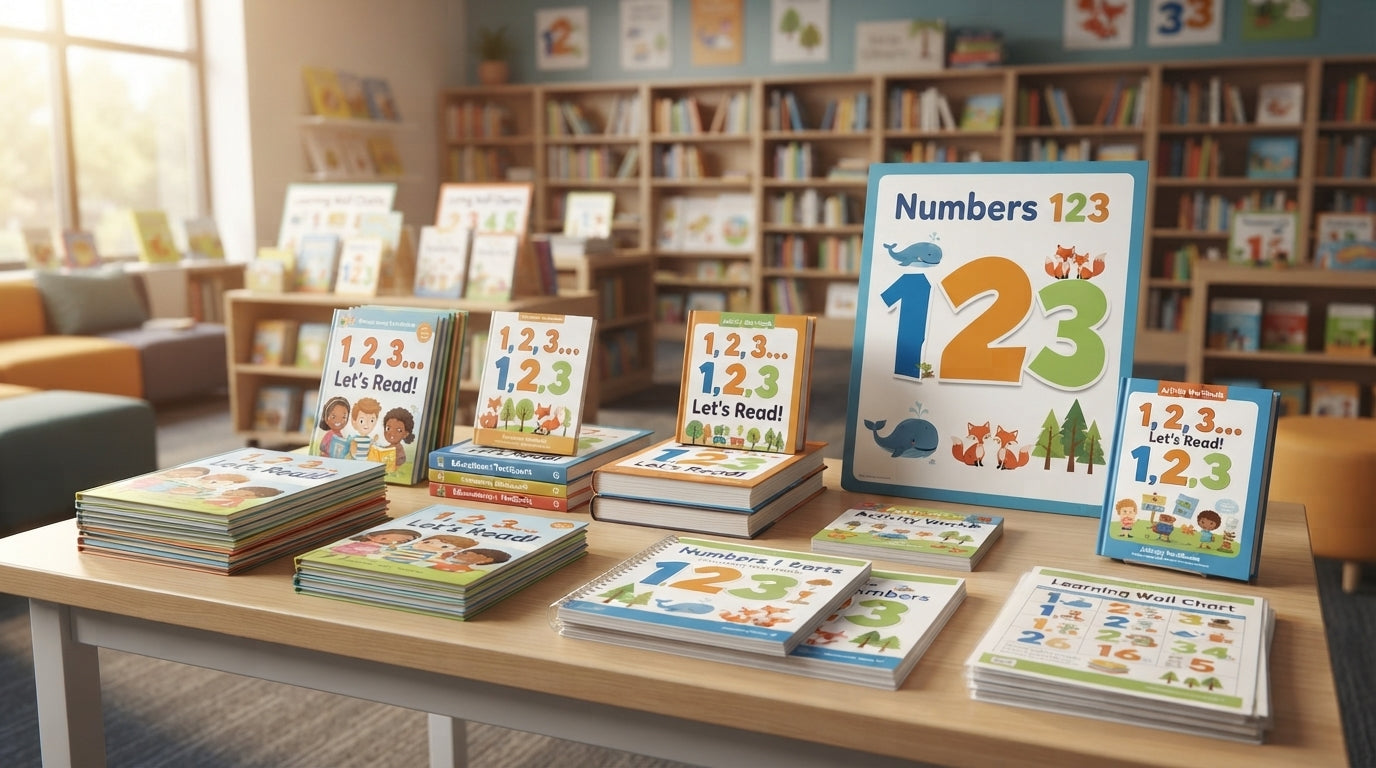
To assist educators and school leaders in selecting curriculum-aligned visual tools, 123 Publishing House offers curated 6-chart packs crafted specifically for primary levels. Below is a detailed overview of the English collection:
4.1 Early Learning, Preschool & Early Mathematics Packs
Foundational packs designed to introduce core cognitive concepts, early numeracy, shapes, and early counting skills to early years learners:
- Early Learning Charts Pack (6 Wall Charts): Introduces core foundational concepts for toddler and kindergarten readiness.
- Preschool Charts Pack (6 Wall Charts): Designed for preschool classrooms focusing on basic identification and vocabulary.
- Preschool Maths Pack (6 Wall Charts): Establishes early number sense, basic counting, and quantity association.
- Early Maths Pack (6 Wall Charts): Builds on beginner mathematical operations, patterns, and problem-solving skills.
- Numbers & Shapes Pack (6 Wall Charts): Focuses on numerical recognition paired with 2D and 3D geometric visual aids.
- Counting & Shapes Pack (6 Wall Charts): Combines quantitative counting exercises with spatial geometry recognition.
4.2 Classroom Management & Foundation Essentials
Essential wall sets tailored for setting up a welcoming, organized, and structurally supportive learning environment:
- Welcome to Class Pack (6 Wall Charts): Creates an inviting classroom atmosphere with motivational daily anchors.
- Classroom Essentials Pack (6 Wall Charts): Highlights core daily routines, rules, and fundamental learning frameworks.
4.3 Language Arts, Literacy & Writing Skills
Comprehensive chart suites targeting phonics, grammar, reading comprehension, and creative composition:
- Language Arts Pack (6 Wall Charts): Introduces fundamental English language arts principles and vocabulary structure.
- Blends & Digraphs Pack (6 Wall Charts): Phonics visual aid breaking down consonant blends, digraphs, and sound blends.
- Parts of Speech Pack (6 Wall Charts): Clearly defines nouns, verbs, adjectives, adverbs, pronouns, and prepositions with examples.
- Grammar Foundations Pack (6 Wall Charts): Covers essential punctuation, sentence construction, and grammatical correctness.
- Reading Skills Pack (6 Wall Charts): Enhances comprehension strategies, main idea extraction, and vocabulary expansion.
- Writing Skills Pack (6 Wall Charts): Guides students through sentence mechanics, essay structure, and paragraph development.
- Good Writing Pack (6 Wall Charts): Focuses on editing, descriptive language, tone, and effective writing techniques.
4.4 Human Biology, Health & Anatomy Systems
Detailed STEM visual chart collections covering human biology, internal anatomy, sensory perception, and hygiene:
- Healthy Habits Pack (6 Wall Charts): Promotes daily hygiene, personal wellness, and healthy lifestyle choices.
- Me & My Body Pack (6 Wall Charts): Introductory body anatomy and self-awareness visual guides for primary grades.
- Cross Sections of Human Senses Pack (6 Wall Charts): Explores the biological mechanisms behind vision, hearing, taste, smell, and touch.
- Exploring the Human Body Pack (6 Wall Charts): Comprehensive biological overview of organs, skeletal structures, and physiology.
- Vital Body Systems Part 1 Pack (6 Wall Charts): In-depth visual breakdowns of primary circulatory, respiratory, and digestive systems.
- Vital Body Systems Part 2 Pack (6 Wall Charts): Secondary physiological focus covering the nervous, muscular, and skeletal systems.
4.5 Life Sciences & Animal Kingdom Wonders
Science visual aid packs exploring zoology, habitats, and environmental life cycles:
- Animal Wonders Pack (6 Wall Charts): Highlights animal classifications, adaptations, and natural habitats.
- Animals Life Cycles Pack (6 Wall Charts): Detailed biological charts illustrating metamorphosis, growth stages, and life cycles.
Summary Overview of Educational Chart Categories
| Category | Target Grade Level | Primary Educational Objective | Key Visual Elements |
|---|---|---|---|
| Early Years & Maths | Pre-K to Grade 2 | Early numeracy, basic counting & shape recognition | High-contrast shapes, bold numerals & simple counters |
| Language Arts & Phonics | Grade 1 to Grade 5 | Literacy development, grammar, writing & reading skills | Color-coded rules, example sentence callouts & sound guides |
| Human Anatomy & Health | Grade 2 to Grade 6 | STEM biology, body systems, sensory organs & hygiene | Labeled anatomical cross-sections & systemic diagrams |
| Life Sciences & Animals | Grade 1 to Grade 5 | Zoological concepts, life cycles & ecological systems | Step-by-step cycle loops, animal species illustrations |
5. Choosing Wall Charts by Age Group
Subject matters, but age decides how much information a chart can carry before it stops being read. The table below matches each age band to the chart packs that suit it, and to a free subject guide you can read before you order.
| Age | What Works at This Stage | Chart Packs | Free Guide |
|---|---|---|---|
| 3–4 years | One concept per chart, large images, almost no text. Children at this stage read the picture, not the label. | Early Learning Charts, Preschool Charts | Occupation Picture Chart |
| 5–6 years | Letter sounds, counting to twenty, and classroom routine. Charts start carrying short labelled words. | Preschool Maths, Numbers & Shapes, Welcome to Class | Number Chart 1–20, Lowercase Alphabet Chart |
| 7–8 years | Grammar rules and written practice. A chart can now hold a rule plus two or three worked examples. | Parts of Speech, Blends & Digraphs, Language Arts | Preposition Chart, Adverb Chart |
| 9–10 years | Sentence construction, composition, and labelled science diagrams with real terminology. | Grammar Foundations, Writing Skills, Exploring the Human Body | Conjunction Chart, English Dictation Words |
Two practical notes apply across all bands. A chart that sits above a child's sight line is decoration, not a teaching tool — mount at the height of the youngest reader in the room. And a chart only earns its wall space while the topic is current, so rotating one pack in and one pack out each term keeps the display being read rather than ignored.
6. How to Select the Right Wall Charts (Pedagogical Standards)
Equipping a school or classroom with educational charts requires intentional evaluation. To maximize academic outcome, consider these four professional selection criteria:
1. Developmental & Grade-Level Appropriateness
Younger students (Pre-K to Grade 1) require large visual images with minimal textual clutter, such as the Numbers & Shapes Pack. Older students benefit from dense information architectures like the Vital Body Systems Pack.
2. Visual Hierarchy & Legibility
Charts must feature clear typographical hierarchy, distinct color contrasts, and legible fonts readable from anywhere in the classroom. Avoid overly crowded designs that cause visual sensory overload.
3. Material Quality & Lamination Durability
Classroom visual aids experience continuous exposure. High-grade lamination protects charts against tearing, dust, and moisture while allowing teachers to utilize dry-erase markers during active teaching sessions.
4. Curriculum Alignment
Ensure charts use standardized terminology, metric systems, and grammar classifications aligned directly with your institution's core curriculum standards (e.g., Common Core, Cambridge, or International Baccalaureate).
7. Strategic Placement of Wall Charts in the Classroom
The spatial arrangement of charts within a classroom significantly impacts their instructional efficacy. Strategic positioning guarantees optimal engagement:
- Front of Wall Display (Focal Zone): Place high-frequency reference charts directly beside the main whiteboard. Literacy tools like Blends & Digraphs Pack or Parts of Speech Pack belong here for instant teacher reference.
- Eye-Level Student Mounting: Mount interactive or detailed science charts—such as Cross Sections of Human Senses—at student eye-level to encourage up-close examination during group tasks.
- Dedicated Learning Stations (Subject Corners): Establish distinct zones within the classroom. Create a "STEM Corner" featuring biology charts and a "Writing Lab" featuring Writing Skills Pack.
8. Free Subject Guides: What Goes on Each Chart
Before ordering a pack, it helps to see exactly what a chart on that subject contains. Each guide below sets out the content of one subject — the rules, the examples, and how teachers use it in class.
English Grammar & Literacy
- Preposition Chart in English: position, time and movement prepositions with classroom examples.
- Chart of Adverbs: adverb types and where each one sits in a sentence.
- Types of Conjunction: coordinating, subordinating and correlative conjunctions.
- Vocabulary Chart: building word banks that children actually use in writing.
- English Dictation Words: graded word lists for spelling and dictation practice.
- Lowercase Alphabet Chart: letter formation for early writers.
Maths & Early Numeracy
- Number Chart 1–20: counting, numeral recognition and quantity matching.
Health, Behaviour & Classroom Culture
- Healthy Habits Chart: hand washing, dental care and daily routines.
- Magic Words Chart: please, thank you, sorry — and how to display them.
- Friendship Chart: social skills and conflict resolution for primary classes.
- Good Behaviour: classroom expectations set out visually.
- Motivational Charts for Students: reward and encouragement displays.
- Welcome to Our Class Banner: setting up the room for a new term.
The World Around Us
- Occupation Picture Chart: jobs and community roles for early years.
- Arabic Alphabet Flashcards: for bilingual classrooms teaching both scripts.
9. Frequently Asked Questions (FAQ)
Q1: What are the standard dimensions of 123 Publishing House wall chart packs?
Our wall chart packs are produced in large poster formats (typically 50x70 cm), ensuring all visual diagrams and text elements remain clearly readable from across the classroom.
Q2: Are these educational chart packs suitable for home schooling?
Yes, absolutely. Homeschool educators utilize these 6-chart packs to create structured, immersive learning spaces at home, supporting independent study and subject mastery.
Q3: Can dry-erase markers be used on these charts?
Yes. The high-quality finish on our laminated wall charts enables dry-erase interaction, allowing teachers to highlight words, trace numbers, or circle anatomical parts during live lessons.
Q4: Are bulk order discounts available for schools and institutional buyers?
Yes. Educational institutions ordering in bulk for whole-school setups can browse our full catalog online or contact customer support directly for customized institutional orders.
Q5: Which wall charts are right for a specific age group?
As a rule, one concept per chart for ages 3 to 4, short labelled words for ages 5 to 6, a rule with worked examples for ages 7 to 8, and full labelled diagrams from age 9. The age table in this guide matches each band to the packs built for it.
Q6: How many wall charts should a single classroom display at once?
Six to eight charts on display at any one time works better than a full wall. Keep the current topic in the focal zone beside the board, hold the rest in storage, and rotate them in as the term moves on.
10. Conclusion: Transform Your Classroom into an Interactive Learning Space
Investing in high-impact educational wall charts is one of the most effective strategies to enhance classroom environment, improve academic focus, and support visual learning. By surrounding primary students with clear, colorful, and curriculum-aligned visual reference tools, you empower them to explore, recall, and master fundamental skills independently.
Explore the Complete English Wall Chart Collection Today!
Upgrade your school or homeschool environment with premium 6-chart educational packs from 123 Publishing House.
Shop the Official Wall Charts Store Now




Leave a comment
This site is protected by hCaptcha and the hCaptcha Privacy Policy and Terms of Service apply.