Ultimate Guide: Choosing Educational Books for Kids
Selecting the right educational books for kids is one of the most impactful decisions parents, teachers, and homeschool educators can make to secure a child's lifelong academic and emotional development. From the very first touch of a textured board book in infancy to the complex problem-solving required by advanced STEM workbooks in upper elementary grades, high-quality books serve as the fundamental scaffolding for cognitive growth. In an era saturated with screen-based learning and rapid digital distractions, physical and structured print resources provide an irreplaceable sensory, tactile, and deep-focus learning environment that cultivates critical thinking, language acquisition, and emotional intelligence across primary elementary education.
[Insert image here: Young bright preschool children sitting at a classroom table exploring colorful educational workbooks with their teacher]
Empowering Educators, Parents, and Homeschoolers Through Research-Backed Selection Strategies
Navigating the vast landscape of children's literature, foundational phonics books, and academic titles can feel overwhelming. With thousands of options available, identifying books that match a child's precise developmental stage, learning style, and academic goals requires a strategic approach grounded in early childhood education. At 123 Publishing House, our editorial team collaborates with early childhood development specialists, literacy coaches, and classroom educators to design and curate books that meet the highest pedagogical standards. This ultimate guide is designed as an exhaustive, actionable roadmap to help you choose the best learning books for children, whether you are building a home library, designing a homeschool curriculum, or equipping a vibrant school classroom with essential teacher resources.
Bridging Developmental Milestones and Academic Excellence
Every child develops along a unique trajectory. A book that inspires one four-year-old may frustrate another if the text complexity, concept load, or physical format does not align with their current neurodevelopmental stage. Throughout this guide, we break down book selection by age categories, specific subject learning goals—ranging from Arabic and English language acquisition to STEM, Islamic Education, and foundational Math—and practical classroom and home integration strategies. By pairing research-backed pedagogical insights with direct access to physical resources like our comprehensive Complete Books Collection, tailored Educational Collections Catalog, and specialized Global Learning All-Products Directory, you will gain the exact tools necessary to make confident, transformative educational investments for your learners.
Explore Early Literacy Resources
Discover our foundational reading series and curated learning sets designed specifically for early learners transitioning into structured literacy.
Browse English Collections Catalog →Why Educational Books Matter in Modern Early Childhood & Elementary Education
The human brain undergoes its most rapid structural growth during the first decade of life. During these formative years of early childhood education, neural pathways are established based on the quality, frequency, and depth of environmental stimuli. Educational books act as cognitive catalysts during this critical window. Unlike passive entertainment media, reading and interactive workbook exercises demand active mental processing, visual tracking, symbolic decoding, and narrative synthesis.
Research in developmental psychology consistently demonstrates that early exposure to print-rich environments directly correlates with higher academic achievement, expanded vocabulary, stronger spatial reasoning, and superior social-emotional regulation later in life. High-quality school learning materials do not merely teach facts; they train the mind how to process, organize, and retain information efficiently.
- Cognitive Pathway Activation: Physical books engage multiple sensory modalities. When a child turns a page, traces a letter, or scans a visual diagram, they activate the visual, motor, and auditory centers of the brain simultaneously.
- Deep Attention and Focus Training: In a world dominated by rapid screen transitions, physical books teach sustained attention, patience, and linear information processing, which are essential prerequisites for higher-level academic research and complex mathematical reasoning.
- Linguistic Mastery and Oral Fluency: Exposure to structured print exposes children to rare vocabulary words, complex sentence structures, and correct grammatical frameworks that rarely occur in everyday spoken conversation.
- Emotional and Social Scaffolding: High-quality narrative books allow children to explore complex human emotions, diverse perspectives, and social scenarios in a safe, guided setting, laying the foundation for strong empathy and self-regulation.
Recommended Multi-Language Resources
- English Language Collection — Curated English readers & phonics series.
- Arabic Books & Stories Collection — Foundational Arabic literacy titles.
- Interactive Audio Reading Pen (Arabic/English) — Smart audio integration for multi-sensory pronunciation.
Related Regional Catalog Options:
English Store Collections | International Zone Collections | All Zone Products Directory
The Multifaceted Benefits of High-Quality Educational Books
Investing in targeted, developmentally appropriate children learning books yields measurable dividends across every domain of a child's development. Whether used in a formal school setting, a structured homeschool setup, or during daily parent-child bonding at home, educational books provide four foundational pillars of developmental support:
1. Cognitive and Intellectual Acceleration
Educational books introduce systematic problem-solving frameworks. Workbooks that feature progressive logic puzzles, spatial pattern recognition, and scientific classification force young minds to form abstract concepts from concrete visual representations. This cognitive scaffolding directly enhances working memory, fluid intelligence, and analytical capacity.
2. Language Acquisition and Literacy Scaffolding
Early literacy begins long before formal reading instruction starts. Phonemic awareness, print concepts, and vocabulary breadth are continuously constructed through interactive book reading. By utilizing resources such as our Arabic Language Educational Collection alongside bilingual readers, educators can reinforce phonics rules, sight word recognition, and contextual reading fluency, ensuring children transition smoothly from "learning to read" to "reading to learn."
3. Fine Motor Skills and Kinesthetic Mastery
For toddlers and preschoolers, physical interaction with educational workbooks is vital for motor development. Tasks such as holding a crayon, tracing dashed lines, navigating mazes, and turning heavy board pages strengthen the small muscles in the hands and fingers. This pincer grasp development and hand-eye coordination are direct precursors to fluent handwriting, artistic expression, and independent tool usage.
4. Independent Learning Habits and Self-Efficacy
When a child successfully completes a page in a structured workbook or finishes reading an entire story independently, they experience an immediate sense of intrinsic achievement. High-quality educational books are structured with clear instructions and progressive difficulty levels, allowing children to build confidence, self-reliance, and a growth mindset that views academic challenges as rewarding milestones.
Recommended Foundation Toolkits
- My Skills Box Educational Pack — Comprehensive skill-building workbook kit.
- My First Words Educational Pack — Essential early vocabulary builder.
How to Choose Educational Books by Age Group
Child development is marked by distinct neurological and physical milestones. A book selection strategy that works brilliantly for a seven-year-old will fail if applied to a toddler. To ensure maximum engagement and educational value, book choices must align precisely with your child's age group.
| Age Group | Primary Learning Goals | Recommended Book Format |
|---|---|---|
| Ages 0–3 | Sensory exploration, basic object identification, sound recognition | Durable board books, touch-and-feel textures, high-contrast imagery |
| Ages 3–5 | Pencil control, alphabet introduction, counting up to 20 | Tracing workbooks, preschool books, thick outline coloring titles |
| Ages 5–7 | Phonics decoding, sight words, single-digit math operations | Decodable phonics readers, elementary workbooks, simple storybooks |
| Ages 7–10 | Reading comprehension, multi-digit arithmetic, scientific inquiry | Illustrated chapter books, STEM project guides, grammar workbooks |
| Ages 10+ | Analytical essay writing, pre-algebra, critical source evaluation | Subject encyclopedias, advanced STEM workbooks, ethics & history guides |
Ages 0–3: Sensory Exploration and Early Concept Foundations
In infancy and toddlerhood, books are physical objects to be explored with all senses. Learning at this stage revolves around auditory discrimination, object identification, and tactile manipulation.
- Key Features: Sturdy board construction, non-toxic rounded edges, bold colors, and real-world visual associations.
- Recommended Early Board Titles:
Ages 3–5: Preschool Preparation, Alphabet & Numeracy
Preschoolers are undergoing a massive expansion in language expression, curiosity, and motor control. They are ready for structured early learning concepts presented through clear visual formats, tracing activities, and guided letter formation.
- Key Features: Tracing guides, large clear fonts, interactive counting elements, and comparative concept matching.
- Recommended Preschool Core Titles:
Ages 7–10+: Middle Elementary Comprehension & Independent Reading
Children aged 7 and above require books that deepen vocabulary, enhance critical reading comprehension, and support curriculum-aligned subject expansion across general science, history, and advanced math concepts.
- Explore Age-Specific Collections: Navigate directly to our dedicated Books for 9–10 Years Collection for age-tailored literary and educational resources.
Explore Language Specific Collections:
Arabic Zone B Collection | English Zone B Collection | Arabic Primary Collection
Practical Strategies for Home & Classroom Integration
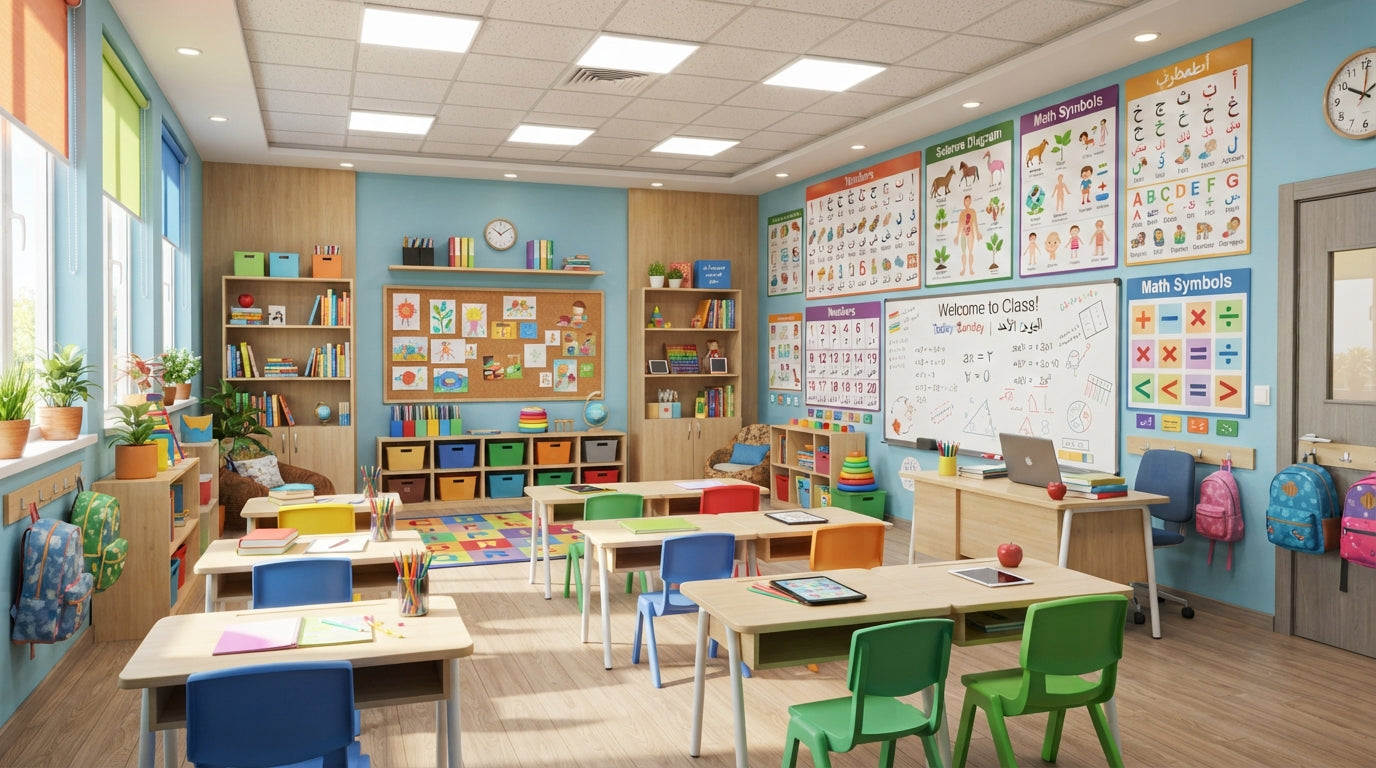
Selecting high-quality educational books is only the first step. Maximizing their impact requires thoughtful implementation in daily learning routines, whether at home or inside a bustling classroom.
1. Creating a Dedicated Learning Nook
Designate a quiet, well-lit space stocked with accessible books, workbooks, writing tools, and interactive equipment. Displaying books with covers facing outward rather than spines encourages young children to independently select titles that spark their interest.
2. Combining Print with Interactive Audio Tools
For bilingual learners and early readers, combining physical text with audio assistance dramatically accelerates correct pronunciation and reading fluency. Utilizing modern tools like our Interactive Audio Reading Pen allows children to hear words spoken by native speakers instantly, reinforcing independent self-correction.
3. Implementing 15-Minute Daily Workbook Routines
Consistency is far more effective than sporadic long study sessions. Integrating 15 to 20 minutes of daily tracing or pencil-control exercises using comprehensive kits like My Skills Box Educational Pack builds a disciplined habit without causing cognitive fatigue or frustration.
Transform Your Child's Learning Journey Today
Explore our full suite of research-backed educational books, interactive reading tools, and curated learning packs designed to ignite curiosity and foster academic excellence.



Leave a comment
This site is protected by hCaptcha and the hCaptcha Privacy Policy and Terms of Service apply.